

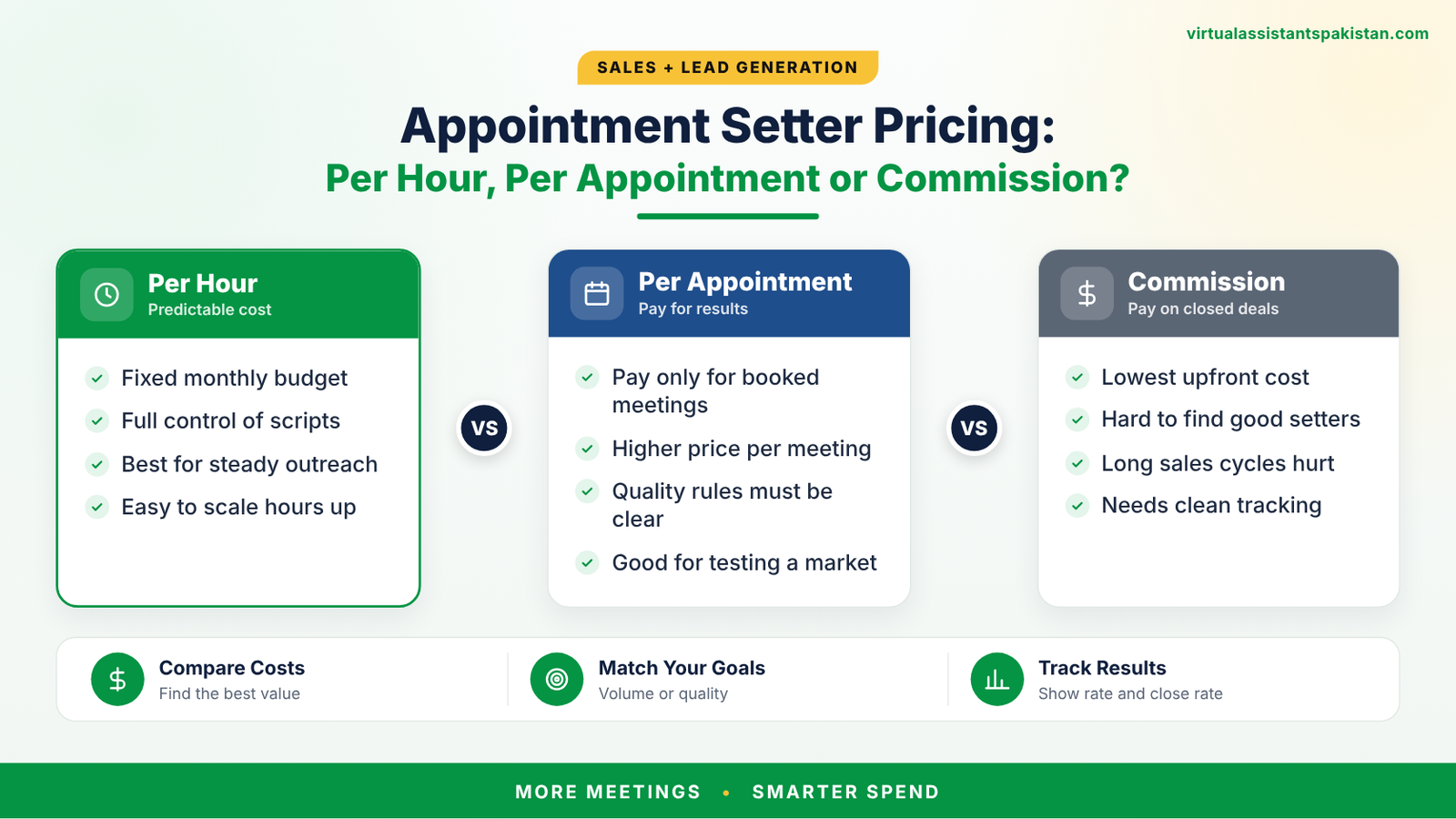
Appointment setter pricing usually comes in three shapes. You pay for time, you pay for each booked appointment, or you pay a commission when a deal closes. Each model puts the risk on a different person, and the cheapest-looking one is not always the cheapest in practice. This guide compares the three, shows typical price ranges and helps you pick. If you want a trained caller on a flat monthly plan, take a look at our lead generation virtual assistant services.
| Model | How you pay | Typical range | Best for | Watch out for |
|---|---|---|---|---|
| Hourly | Time worked | About $16 to $50 an hour for US setters; $5 to $6 an hour for a VA with us | You already have lists, a script and a CRM | You manage the work and measure results |
| Monthly plan or retainer | Fixed fee each month | About $2,000 to $5,000 a month for agency campaigns; $480 to $800 for a VA with us | Ongoing outreach with steady volume | You pay whether or not meetings happen |
| Per appointment | Each booked meeting | About $50 to $500 per appointment | Clear offer and an easy definition of “qualified” | Volume over quality, no-shows, mismatched meetings |
| Commission | Share of closed deals | No standard range, so agree it in writing | Long sales cycles and high-value deals | Late payment, and the setter does not control the close |
Agency and per-appointment ranges are drawn from published guides by Belkins, SalesBread and Intelemark. They are mostly B2B figures and vary by industry.
Hourly works when you already know which message, list and channel perform. You buy time and control the process. It is also the easiest model to scale: add hours for a campaign, then release them.
This model feels low risk because you only pay for meetings. The catch is the incentive. A provider paid per booking fills your calendar, which is not always the same as filling it with buyers.
Commission ties the setter’s pay to closed revenue. It suits high-value deals where you can wait for the sale. It is rarely a good fit for short sales cycles, because the setter hands over the lead and then has no say in what happens next.
Most pricing disputes come from one word. Before you agree to any model, write down what a billable or successful appointment means. A good definition covers:
Intelemark suggests keeping cancellations below 15% and sending reminders 24 hours and 1 hour before each meeting. Both are easy to put in a setter’s routine.
20 hours a week at $6 an hour. Good for one offer and steady lead volume.
40 hours a week at $5 an hour. Covers calling, follow-up, booking and reminders.
Add hours for a campaign or a launch, then release them. No long contract.
These are our standard rates. Plans are billed monthly with no lock-in. Your own tools, such as a dialer or lead lists, are extra.
To compare any quote fairly, turn it into one number: monthly cost divided by appointments that were actually held. The figures below are examples to show the method, not promises. Your results depend on your offer, list and market.
| Example | Part-time VA | Full-time VA |
|---|---|---|
| Monthly cost | $480 | $800 |
| Appointments booked (assumed) | 12 | 24 |
| Held at 70% (assumed) | 8.4 | 16.8 |
| Cost per held appointment | about $57 | about $48 |
Compare that with the $50 to $500 per-appointment prices in published guides. Then add your tool costs and your own time for reviewing calls. The right choice is the model with the lowest cost per held appointment that still delivers the right buyers.
| Your situation | Model to start with |
|---|---|
| You have lists, a script and a CRM, and want control | Hourly or a monthly VA plan |
| You want no fixed cost and meetings are easy to define | Per appointment, with a written definition and a no-show credit |
| Deals are large and sales cycles are long | Monthly plan, or a base rate plus a bonus on closed deals |
| You are not sure yet | A part-time VA for 30 days, then measure |
Tell us your offer, target customer and hours. We will match you with a VA who knows lead generation virtual assistant work.
Get an Appointment Setter| Metric | What it shows | How to check |
|---|---|---|
| Appointments booked | Setter activity and list quality | Weekly CRM count |
| Held rate | Whether booked meetings actually happen | Held divided by booked |
| Qualified rate | Whether meetings match your target customer | Share of held meetings your sales team accepts |
| Cost per held appointment | The real price of each meeting | Monthly cost divided by held appointments |
| Appointment-to-deal rate | Whether meetings turn into revenue | Deals won divided by held appointments |
| Lead response time | How fast new leads get a first call | Minutes from enquiry to first contact |
Intelemark puts typical appointment-to-deal conversion at 15% to 20%, though it varies by industry. Note your own numbers before the setter starts so you can see what changed.
How much does an appointment setter cost?
It depends on the model. Published US guides show roughly $16 to $50 an hour, $2,000 to $5,000 a month for agency retainers and $50 to $500 per appointment. A VA from us is $5 to $6 an hour, which is about $480 a month part time and $800 a month full time.
Is it better to pay per hour or per appointment?
Pay per hour when you already have a working script and list and want control. Pay per appointment when your offer is simple and you can define a qualified meeting clearly. In both cases, measure cost per held appointment.
What is a fair price per appointment?
Published ranges are wide, from about $50 to $500, because deal size and buyer difficulty vary. A fair price is one that leaves you profitable after your close rate. Multiply your average deal value by your close rate to see what a meeting is worth.
Can I pay an appointment setter on commission?
You can, but it works best for high-value deals with long sales cycles. Agree the percentage, the payment date and how attribution works in writing. If you want a bonus on held appointments, agree it before the trial starts.
How many appointments can a VA set?
There is no fixed number. It depends on your offer, your lists and how easy your buyers are to reach. No provider can honestly promise a set number, so use the trial to measure your own results.
Read next
Remote appointment setter: cost-effective sales support
From $5 an hour, with a 7-day risk-free trial.
See lead generation virtual assistant servicesWe typically reply in minutes
👋 Welcome! Tell us a little about yourself and we'll help you find the right virtual assistant.
WhatsApp us