

Healthcare Operations Guide
Healthcare practices spend significant time documenting encounters, coordinating appointments, managing records and following up on administrative tasks. A medical scribe and a medical virtual assistant can both help reduce workload, but their responsibilities are not the same.
This guide compares their duties, workflows, costs, privacy considerations and hiring requirements so you can choose support that fits your practice.
1. What Is a Medical Scribe?
A medical scribe helps document patient encounters on behalf of a clinician. Depending on the practice’s workflow, a scribe may work in person or remotely and may assist with preparing clinical notes in an electronic health record (EHR) system.
The main objective is to help clinicians manage documentation more efficiently while allowing them to focus on the patient. The clinician remains responsible for reviewing and validating the clinical record according to applicable professional and organizational requirements.
Typical medical scribe responsibilities
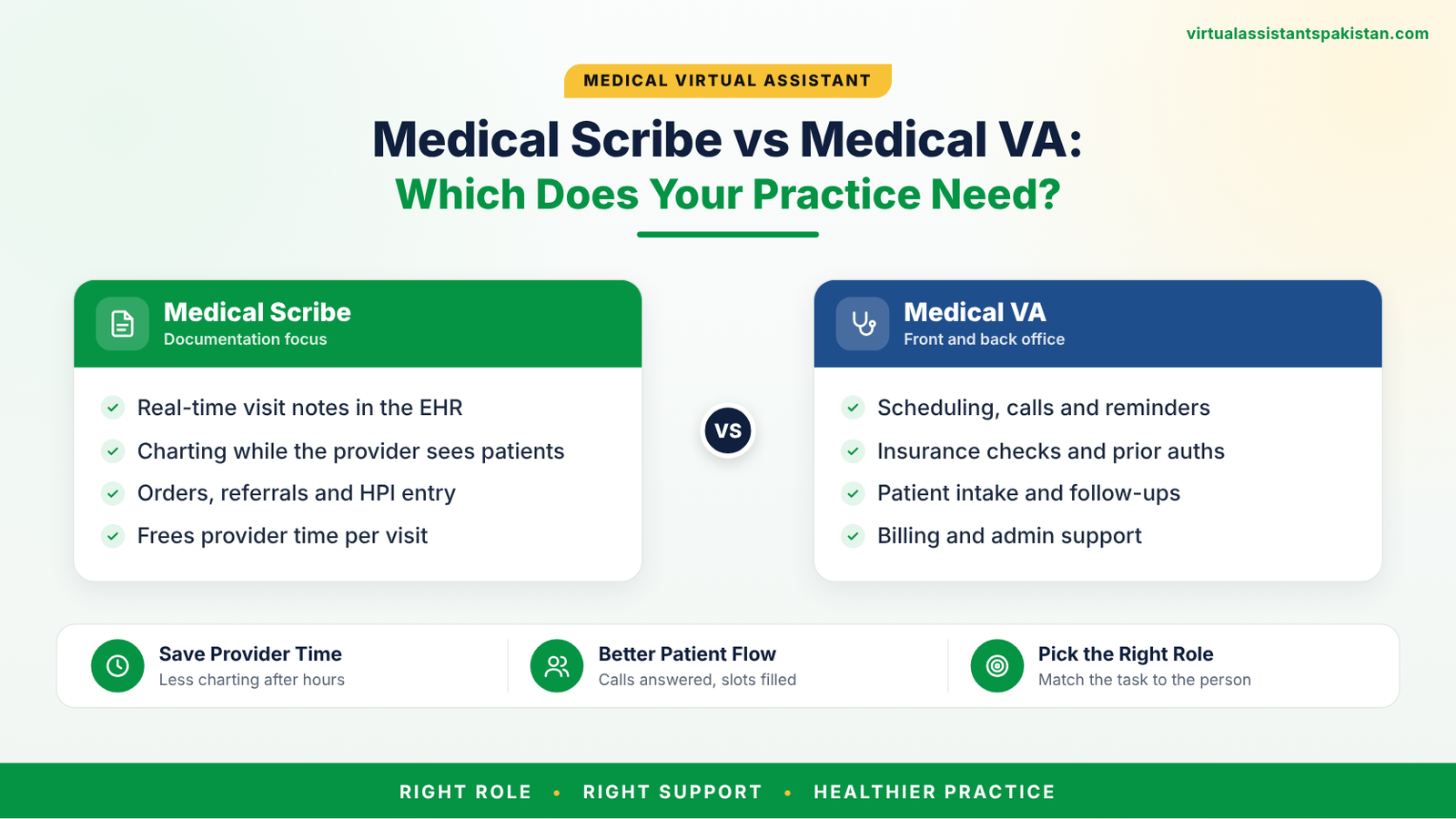
- Documenting clinician-patient encounters based on authorized instructions.
- Organizing relevant history, symptoms and examination details supplied during the encounter.
- Preparing draft notes in the designated EHR system.
- Recording relevant information for clinician review.
- Following established documentation templates and terminology standards.
- Flagging unclear, missing or inconsistent information for clarification.
A scribe should not independently diagnose a patient, invent missing clinical details or make treatment decisions outside the person’s authorized role. Documentation must accurately reflect the encounter and follow the practice’s review and approval process.
2. What Is a Medical Virtual Assistant?
A medical virtual assistant (medical VA) provides remote administrative or operational support to a healthcare practice. Some VAs focus on front-desk duties, while others have training in scheduling, medical records administration, billing support or other defined workflows.
Unlike a role focused primarily on clinical documentation during encounters, a medical VA can support several stages of the patient journey, depending on training, permissions and the services agreed with the practice.
Common medical VA responsibilities
- Scheduling appointments and managing calendar changes.
- Sending approved appointment reminders and follow-up messages.
- Handling routine phone calls and administrative inquiries.
- Updating permitted demographic or administrative information.
- Organizing documents and routing records to the appropriate team.
- Checking insurance information or assisting with eligibility workflows when trained and authorized.
- Supporting billing administration and tracking outstanding administrative tasks.
- Maintaining task logs and coordinating referrals according to practice procedures.
Not every medical VA is qualified for every task. Clinical documentation, insurance workflows and billing responsibilities may require specific training, access permissions and supervision. Define the scope of work before hiring.
3. Medical Scribe vs Medical VA: Key Differences
The biggest difference is the primary purpose of each role. A medical scribe concentrates on clinical encounter documentation, whereas a medical VA generally supports a wider range of administrative operations.
| Comparison | Medical scribe | Medical virtual assistant |
|---|---|---|
| Primary focus | Clinical encounter documentation | Administrative and operational support |
| Typical work | Preparing notes from clinician encounters | Scheduling, calls, records and workflow coordination |
| Timing | Often linked to patient encounters | May support work throughout the day |
| Systems | Usually EHR and documentation tools | May use calendars, phone systems, EHR and administrative tools |
| Clinical context | Needs familiarity with clinical terminology and documentation | Needs training suited to assigned duties |
| Supervision | Clinician review of documentation | Manager or designated team supervision |
| Best fit | Practices with a significant documentation workload | Practices with recurring administrative bottlenecks |
These roles can overlap in some organizations, but the job title alone does not establish a person’s qualifications. Evaluate the actual duties, training, system access and supervision model.
4. Which Tasks Should You Assign to Each Role?
Choose a medical scribe when documentation is the main challenge
If clinicians spend a large portion of their day completing encounter notes, a qualified scribe may help prepare documentation for review. The practice should define how notes are created, when they are completed, how uncertainties are flagged and who signs off on the final record.
A scribe may be particularly relevant when the clinic has a high volume of appointments or a consistent documentation process that can be followed with appropriate training and oversight.
Choose a medical VA when administration is the main challenge
If staff members spend hours scheduling appointments, returning routine calls, tracking referrals or organizing administrative records, a medical VA may offer broader support.
For example, a practice could assign appointment reminders, calendar coordination and administrative follow-up to a VA while clinicians and qualified staff retain responsibility for clinical decisions.
Can a practice use both?
Yes. A larger practice may use a scribe for encounter documentation and a medical VA for scheduling, front-desk coordination and administrative follow-up. The roles should have clearly separated responsibilities so information is routed correctly and tasks are not duplicated.
5. Medical Scribe Cost: What Should You Budget For?
The cost of a medical scribe or medical VA varies by location, experience, employment model, working hours, specialty and task complexity. There is no single price that applies to every practice.
When comparing providers, evaluate the total cost of getting the work done accurately, not just the advertised hourly rate.
Costs to consider for a medical scribe
- Hourly, shift-based or contracted service fees.
- Training in clinical terminology, specialty workflows and EHR documentation.
- Coverage during required clinic hours.
- Quality assurance and clinician review time.
- Technology, secure access and onboarding requirements.
Costs to consider for a medical VA
- Hourly, monthly or task-based service fees.
- Training for scheduling, communication and assigned administrative processes.
- Coverage requirements and time-zone overlap.
- Management, supervision and quality checks.
- Secure technology and account access.
Request a written scope of work that explains what is included, expected coverage, training, reporting, replacement arrangements and any additional charges. Compare quotes based on the same workload and service expectations.
How to estimate potential value
Start by measuring the hours currently spent on the tasks you want to delegate. Estimate the proportion that can realistically be transferred, then compare the resulting time savings with the complete service cost.
For example, if a practice spends 20 hours per week on administrative tasks, do not assume all 20 hours will disappear after hiring a VA. Training, communication and quality review still require time. Use a realistic estimate and reassess after the first few weeks.
6. Patient Privacy, Data Security and Compliance
Both medical scribes and medical VAs may handle sensitive patient information. Remote working arrangements do not remove the practice’s responsibility to protect that information.
For US healthcare organizations, HIPAA requirements may apply depending on the organization, information and service relationship. A provider’s location outside the United States does not by itself determine whether HIPAA applies or remove the obligations of covered entities and business associates.
Before granting access, your practice should:
- Determine which privacy and security requirements apply to the arrangement.
- Use appropriate written agreements, including a business associate agreement when required.
- Provide only the minimum access needed for assigned duties, consistent with applicable requirements.
- Use approved systems, secure authentication and documented access procedures.
- Train staff and contractors on confidentiality, incident reporting and acceptable use.
- Establish how records are reviewed, stored, retained and accessed after the contract ends.
- Verify the provider’s security practices and subcontractor arrangements.
Do not assume that a service is compliant merely because a vendor uses the words “HIPAA compliant” in marketing materials. Confirm the actual controls, agreements and responsibilities with your compliance lead or qualified legal adviser.
7. How to Choose the Right Support for Your Practice
Step 1: Identify the bottleneck
Determine whether clinicians are spending too much time documenting encounters or whether administrative tasks are delaying patient coordination and daily operations.
Step 2: Define the responsibilities
Write a task list that identifies what the person will do, what information they can access, what they must not do and when they should escalate an issue.
Step 3: Check relevant experience
For a scribe, evaluate clinical terminology, documentation accuracy and familiarity with the relevant specialty and EHR workflow. For a medical VA, evaluate communication, scheduling, record handling and the administrative processes involved.
Step 4: Confirm security and supervision
Review confidentiality arrangements, permissions, training and quality checks before the person accesses patient information. Assign a named supervisor and define how errors will be corrected.
Step 5: Start with a controlled pilot
Begin with a clearly defined workload and review accuracy, turnaround time, task completion and staff feedback. Expand responsibilities only after the workflow is working reliably.
If you need broader remote healthcare support, explore our medical virtual assistant services.
For more detail about documentation-focused roles, read our guide to virtual medical scribe duties and benefits. You can also review our medical receptionist job duties guide for front-desk responsibilities.
8. Common Mistakes to Avoid When Hiring
- Choosing by job title alone: Verify skills and responsibilities rather than assuming all providers offer the same services.
- Skipping workflow documentation: Unwritten processes lead to inconsistent notes, missed follow-ups and confusion.
- Giving excessive system access: Assign permissions based on actual job duties and review them regularly.
- Ignoring quality checks: Speed matters, but accurate documentation and reliable administrative work matter too.
- Expecting a VA to make clinical decisions: Keep clinical judgment and regulated professional duties with appropriately qualified professionals.
- Comparing prices without comparing scope: Training, coverage, supervision and security requirements affect the real cost.
Frequently Asked Questions
What is the main difference between a medical scribe and a medical VA?
A medical scribe primarily assists with clinical encounter documentation, while a medical VA usually handles broader administrative tasks such as scheduling, calls, records coordination and approved follow-ups.
Is a virtual scribe the same as a virtual assistant?
No. A virtual scribe focuses on documentation related to patient encounters. A virtual assistant may perform a wider set of administrative duties. Some responsibilities can overlap depending on training and the practice’s workflow.
Which role is better for a small medical practice?
It depends on the main bottleneck. Choose a scribe if clinical documentation is the primary problem, and consider a medical VA if scheduling, calls and administrative coordination consume the most time.
How much does a medical scribe cost?
Pricing varies with experience, specialty, location, coverage and employment model. Obtain comparable quotes and include training, supervision, technology and quality review in your budget.
Can a medical VA work with an EHR system?
A trained and authorized medical VA may perform permitted administrative tasks in an EHR. Access should be limited to the role’s requirements, with appropriate training and privacy safeguards.
Can an overseas medical VA support a US practice?
Potentially, depending on the assigned duties, applicable legal requirements, contractual arrangements and security controls. Review the specific relationship and data access requirements before onboarding.
Can I hire a medical scribe and a medical VA together?
Yes. They can support different parts of the workflow when responsibilities, supervision, access permissions and handoffs are clearly defined.
Looking for Reliable Medical Virtual Assistant Support?
Find administrative support that fits your practice’s workflow, from appointment coordination to other clearly defined healthcare operations.
Explore Medical VA ServicesDisclaimer: This article provides general operational information, not medical, legal or compliance advice. Confirm applicable requirements with qualified professionals before outsourcing healthcare workflows or granting access to patient data.