

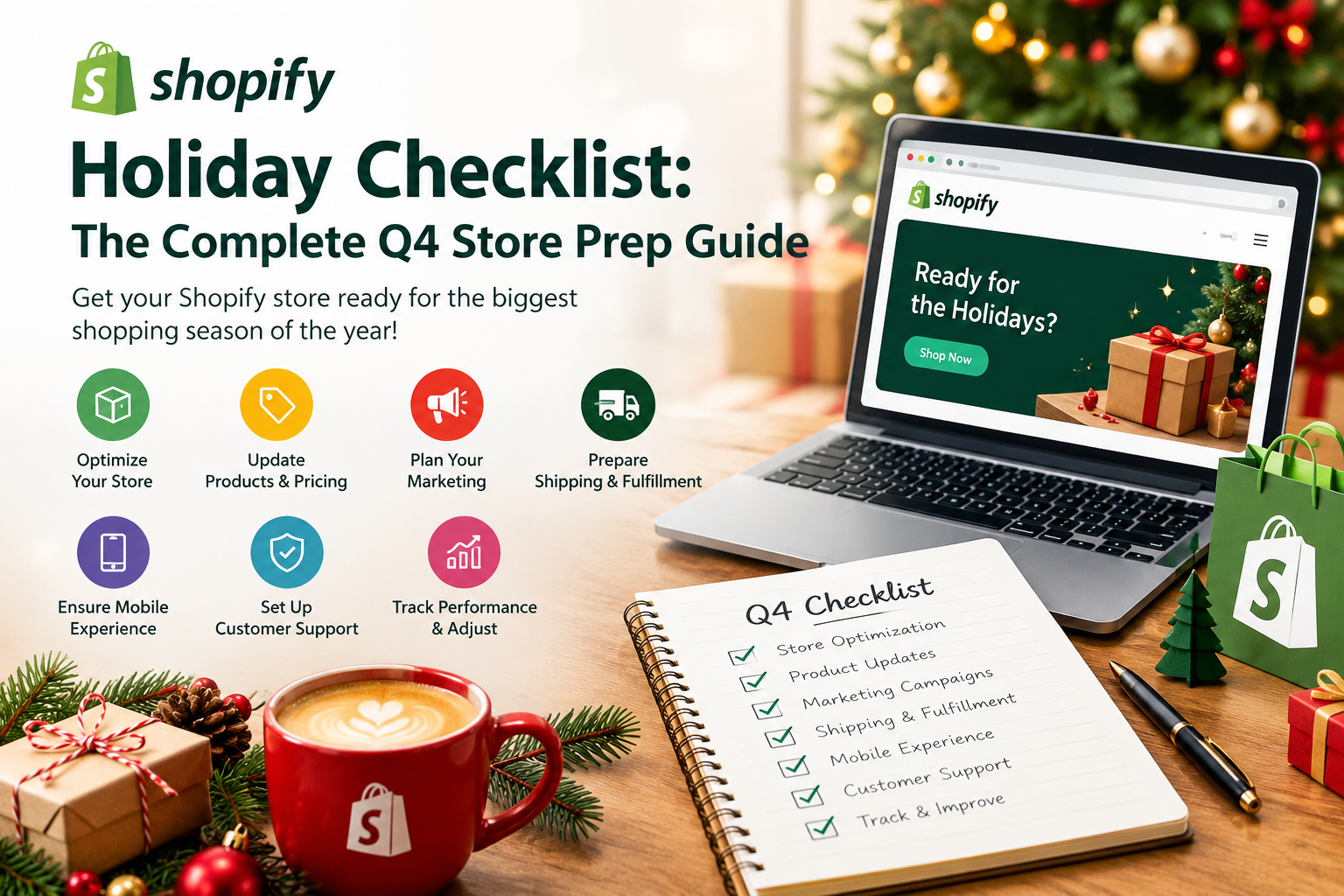
A Shopify holiday checklist is the difference between a Q4 that runs on schedule and a Q4 spent firefighting. For most Shopify merchants, the six-week window from Black Friday through the end of December can account for a third or more of annual revenue which means the preparation work done in October and early November carries more weight than almost anything else on the calendar that year. This guide lays out a complete shopify holiday checklist broken into five areas where holiday-season stores most commonly fall behind: inventory, site performance, app cleanup, customer service capacity, and post-holiday returns and marks which tasks are safe to delegate and which need the owner’s direct judgment.
Before building your own shopify q4 checklist, it helps to separate two kinds of work: tasks that protect revenue you’d otherwise lose (a broken checkout, an out-of-stock bestseller, a missed shipping cutoff), and tasks that grow revenue you wouldn’t otherwise capture (gift guides, bundled offers, upsell flows). Most holiday store prep guides blur the two together. This one keeps them separate, because they need different owners and different timelines and because the protect-revenue tasks should always be scheduled first, since a single broken checkout page during peak traffic costs more than a missed upsell opportunity ever will.
Delegate: these ecommerce VA tasks description updates, alt-text, collection assembly, stock-tracking spreadsheets, supplier lead-time tracking. Owner decides: final pricing and discount depth.
Every installed app adds JavaScript to a storefront, and Q4 traffic spikes expose slow pages fast.
Delegate: compiling the app-use audit, documenting speed-test results, filing support tickets. Owner decides: which apps to cut, since some touch revenue-generating features like upsells.
Order volume in Q4 raises “where’s my order” and sizing questions in near-direct proportion. Planning for it beats reacting to it.
Delegate: inbox management, drafting canned responses for approval, updating the cutoff banner on schedule. Owner decides: final wording on anything involving refunds or exceptions.
Returns volume after the holidays is predictable and routinely under-planned.
Delegate: FAQ updates, drafting the email sequence, tracking requests against the extended window. Owner decides: policy exceptions, case by case.
Treat these four sections together as one shopify holiday checklist rather than four separate to-do lists the lead times overlap, so starting the later-stage items on time depends on the earlier ones already being underway.
A workable version of this shopify holiday checklist doesn’t need project-management software. A single shared sheet with four columns Task, Owner, Start Week, Status covering every bullet point above is usually enough, as long as someone actually reviews it weekly rather than building it once in October and never opening it again. The stores that execute this well tend to do a 10-minute Monday check-in through the whole Q4 window, not a single planning session in early fall.
Most stores that fall behind on holiday store prep don’t fail because any single task is hard they fail because no one owns the checklist end-to-end. A shared task board with a named owner and a deadline against each line above turns a list of good intentions into a tracked plan. That single structural change assigning ownership accounts for more on-time Q4 launches than any individual tactic on this page.
If there’s no one internally positioned to own this, the work above is exactly the kind of recurring, checklist-driven task an e-commerce virtual assistant is built for not because it demands deep specialization, but because it demands consistency during the exact weeks an owner has the least spare attention to give it.
What should be on a Shopify holiday checklist? A complete shopify holiday checklist covers four areas: inventory and product-page readiness, site speed and app cleanup, customer service capacity for the order-volume spike, and post-holiday returns handling each with its own lead time, from eight weeks out down to two.
When should Q4 holiday prep start? Inventory and product-page work should start 8–10 weeks before peak season; site-speed and app audits 6–8 weeks out; customer-service planning 4–6 weeks out; and returns-policy prep 2–4 weeks out. Starting earlier on inventory matters most, since stock and listing issues are the hardest to fix under time pressure.
Which holiday-prep tasks can be delegated to a virtual assistant? Description and listing updates, app-use audits, canned-response drafting, inbox management, FAQ updates, and email-sequence drafting are all delegable. Pricing decisions, app-removal calls that touch revenue features, and policy exceptions are better kept with the store owner.
What’s the biggest mistake stores make with Q4 prep? Treating it as a single planning session rather than a tracked, owned process. A shopify holiday checklist built in October and never revisited performs no better than no checklist at all the value comes from weekly follow-through, not the initial list.
If the Q4 workload is less about one-time firefighting and more about ongoing, week-over-week store management inventory syncing, listing updates, customer-service coverage through the whole peak window a dedicated Shopify virtual assistant can take on this shopify holiday checklist as a standing responsibility, rather than a favor asked of whoever on the team has the least on their plate.
We typically reply in minutes
👋 Welcome! Tell us a little about yourself and we'll help you find the right virtual assistant.
WhatsApp us