

Denial Management Virtual Assistant: How It Cuts Claim Denials in 5 Steps
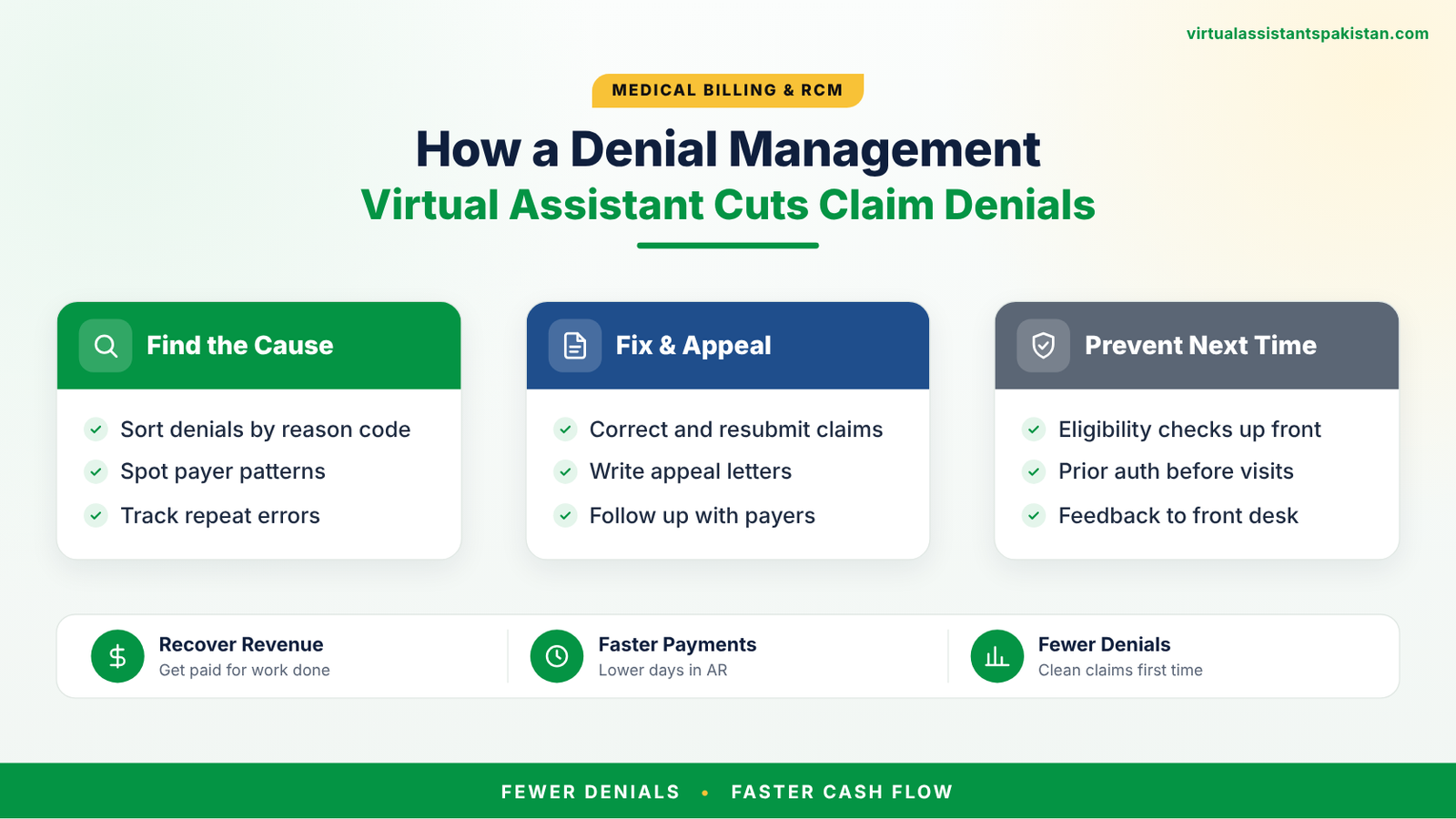
A denial management virtual assistant is a trained remote billing specialist who works your rejected claims every day. They read the CARC code, decide whether the claim is fixable, correct and resubmit it or write the appeal, track it to payment, and report recovery numbers monthly, so denials are worked before filing deadlines expire.
Key takeaways
- Most small practices lose money on denials because nobody works them consistently, not because the denials are unusual.
- Almost every denial falls into one of four causes: data entry, eligibility, documentation or timing.
- The CARC code on the remittance tells you why the payer denied the claim, so read it first.
- Speed decides recovery. Claims reviewed within days can be fixed. Claims reviewed after the filing window usually cannot.
- Track four monthly numbers: denials by code, days to first touch, share resolved in the window, and dollars recovered versus written off.
Every practice gets denied claims. That part is normal. What costs real money is what happens next: the denial lands in a pile, nobody owns it, and the filing deadline quietly passes. A denial management virtual assistant fixes this by making denial follow-up somebody's full-time job.
At Virtual Assistants Pakistan, our medical billing assistants work denials for US practices every day. This guide shows the exact process they follow, the codes they see most, and the numbers you should expect to receive from any denial management VA, ours or anyone else's.
Why do claims get denied in the first place?
Almost every denial traces back to one of four causes:
- Data entry problems. A wrong date of birth, a transposed policy number, a misspelled name or a missing provider identifier.
- Eligibility problems. The patient's coverage lapsed or changed and nobody verified it before the visit.
- Documentation problems. The diagnosis codes on the claim do not support the procedure that was billed.
- Timing problems. The claim, or the appeal, was filed after the payer's deadline.
The first three are usually fixable. The fourth often is not, which is why speed is the most important part of denial management.
What does a denial management virtual assistant actually do?
The role is narrow on purpose. The assistant owns the period between "the payer said no" and "the claim is paid or formally closed." In practice that means pulling denials from your billing system or payer portals, interpreting them, correcting claims, drafting appeals with supporting documentation, following up with payers, and reporting results. It does not replace your biller, it takes the unworked pile off your biller's desk. See our full medical billing virtual assistant services for the wider scope of what our team covers.
The 5-step denial management workflow
Step 1: Pull the denial and read the code
Each denial arrives with a Claim Adjustment Reason Code (CARC) on the remittance advice, often paired with a Remittance Advice Remark Code (RARC) that adds detail. The assistant pulls the denial and reads both before touching the claim, because the code says why the payer refused to pay.
Step 2: Sort fixable from not fixable
Not every denial deserves the same effort. A CO-16 caused by a typo can be corrected in minutes. A CO-29 where the timely filing window has already closed is usually a write-off unless you can prove the claim was filed on time. Sorting first keeps your team's hours on claims that can actually be recovered.
Step 3: Fix and resubmit, or write the appeal
For correctable errors, the assistant fixes the claim and resubmits it. For clinical or authorization denials such as CO-50 or CO-197, the assistant drafts the appeal, attaches the chart notes, authorization records or medical necessity letter, and sends it before the appeal deadline. Where a denial stems from a missing authorization, our team also handles the front end through prior authorization support.
Step 4: Track every denial until it resolves
Resubmitting is not the finish line. The assistant logs the denial, the resubmission date and the payer's response, follows up when the payer is slow, and keeps going until the claim is paid, escalated to a second-level appeal, or formally written off with a reason.
Step 5: Report monthly
Every month you receive a short report so you can see whether the process is working. The exact metrics are listed below.
Which CARC codes does a denial management VA see most often?
These five show up constantly in small and mid-size practices. CARC codes are maintained by the X12 Claim Adjustment Reason Code committee, and the "CO" prefix is a group code meaning the contractual obligation sits with the provider rather than the patient.
| Code | What it means | Usually fixable? | Typical action |
|---|---|---|---|
| CO-16 | Claim lacks information or has a submission error | Yes | Find the missing data, correct the claim and resubmit |
| CO-29 | Timely filing limit has passed | Rarely | Appeal only with proof of timely submission, otherwise write off |
| CO-50 | Service not deemed medically necessary | Sometimes | Appeal with chart notes and a medical necessity letter |
| CO-97 | Benefit is included in the payment for another service | Sometimes | Check bundling and modifiers, then correct or appeal |
| CO-197 | Precertification or authorization absent | Sometimes | Obtain a retro-authorization if the payer allows it, then appeal |
Worked example: a CO-16 fixed on the same day
The claim
A practice billed an office visit together with a lab panel. The payer returned the claim with CO-16 because the referring provider NPI was missing.
What the VA did
The assistant read the code, opened the chart, and found the referring provider documented in the visit notes. They added the NPI to the claim and resubmitted it the same day.
The result
The payer paid the claim within twelve business days. Nothing about the claim was unusual. It was recovered only because someone looked at it the day it came back.
Which metrics should a denial management VA report each month?
- Total denials by CARC code category. Shows which problems repeat, so you can fix the cause upstream.
- Days between denial receipt and first review. Measures how fast the team responds. Shorter is better.
- Percentage of denials resolved within the filing window. Shows how many claims were handled in time.
- Dollar value recovered versus written off. The clearest test of whether the process pays for itself.
These numbers also tell you where to look. If CO-16 keeps rising, the fix is at front-desk data entry. If CO-197 keeps rising, the fix is authorization before the visit. [[Optional: add one real, anonymized client result here, e.g. "Across our denial clients in 2025 the median days-to-first-touch was X." Only include figures you can verify.]]
Denial management VA vs in-house biller vs billing company
| Virtual assistant | In-house biller | Billing company | |
|---|---|---|---|
| Focus | Dedicated to your denials | Split across many tasks | Often percentage-of-collections, many clients |
| Control | Works inside your systems, you see everything | Full | Often limited visibility |
| Cost model | Fixed monthly or hourly | Salary plus benefits | Commonly a percentage of collections |
| Best for | Practices with a denial backlog or no time to follow up | Large practices with steady volume | Practices handing off all billing |
Not sure which fits? Our breakdown of medical billing VA vs billing company vs in-house walks through the trade-offs in detail.
Why speed is the real lever
Payers set hard deadlines for filing, correcting and appealing claims. Medicare, for example, generally requires a claim to be filed within 12 months of the date of service, and commercial payers often allow far less. Appeal windows are separate and also strict, so always confirm the deadline in each payer's contract. The longer a denial waits, the fewer options remain. A virtual assistant whose only job is denials touches every claim within days, and that consistency does more for recovery than any clever appeal letter.
Where this fits in your revenue cycle
Denial management sits at the back end of the revenue cycle, but it informs everything upstream. Clean data entry, eligibility checks and prior authorizations all reduce the denials that reach this stage. A denial management virtual assistant recovers what slipped through and shows you where to tighten the front end. If your team also needs help with charting and records, see how EHR integration with medical virtual assistants works.
Frequently asked questions
What is a denial management virtual assistant?
A denial management virtual assistant is a remote, trained medical billing specialist who reviews denied claims, identifies the cause from the CARC code, corrects and resubmits fixable claims, writes appeals for the rest, and tracks every claim until it is paid or closed.
How does a denial management VA reduce claim denials?
They work denials quickly and consistently, so fixable claims are corrected before deadlines, and the monthly code report shows which upstream problems (data entry, eligibility, authorization) to fix so fewer denials happen next time.
Can a virtual assistant write insurance appeals?
Yes. A trained assistant can draft appeal letters and gather the supporting records. Many practices have a clinician or billing lead review clinical appeals, such as CO-50 medical necessity denials, before submission.
Which denials are worth appealing?
Denials caused by correctable errors (CO-16), a missing authorization that can be obtained retroactively (CO-197), or a medical necessity decision your records can answer (CO-50) are good candidates. Claims past the timely filing limit (CO-29) are hard to recover without proof of on-time submission.
How fast should denials be reviewed?
As soon as they arrive. Track "days to first touch" every month. In the worked example above, the claim was corrected the same day and paid within twelve business days.
Is a VA HIPAA compliant?
[[Replace with your real compliance statement, e.g. "Our assistants sign a BAA and NDA, work inside your secured systems, and complete HIPAA training before handling PHI." Only state what is true for your company.]]
How much does a denial management virtual assistant cost?
Pricing depends on claim volume and hours. Our medical billing assistants start from a published hourly rate, and you can see current options on our medical billing VA page or request a quote on a discovery call.