

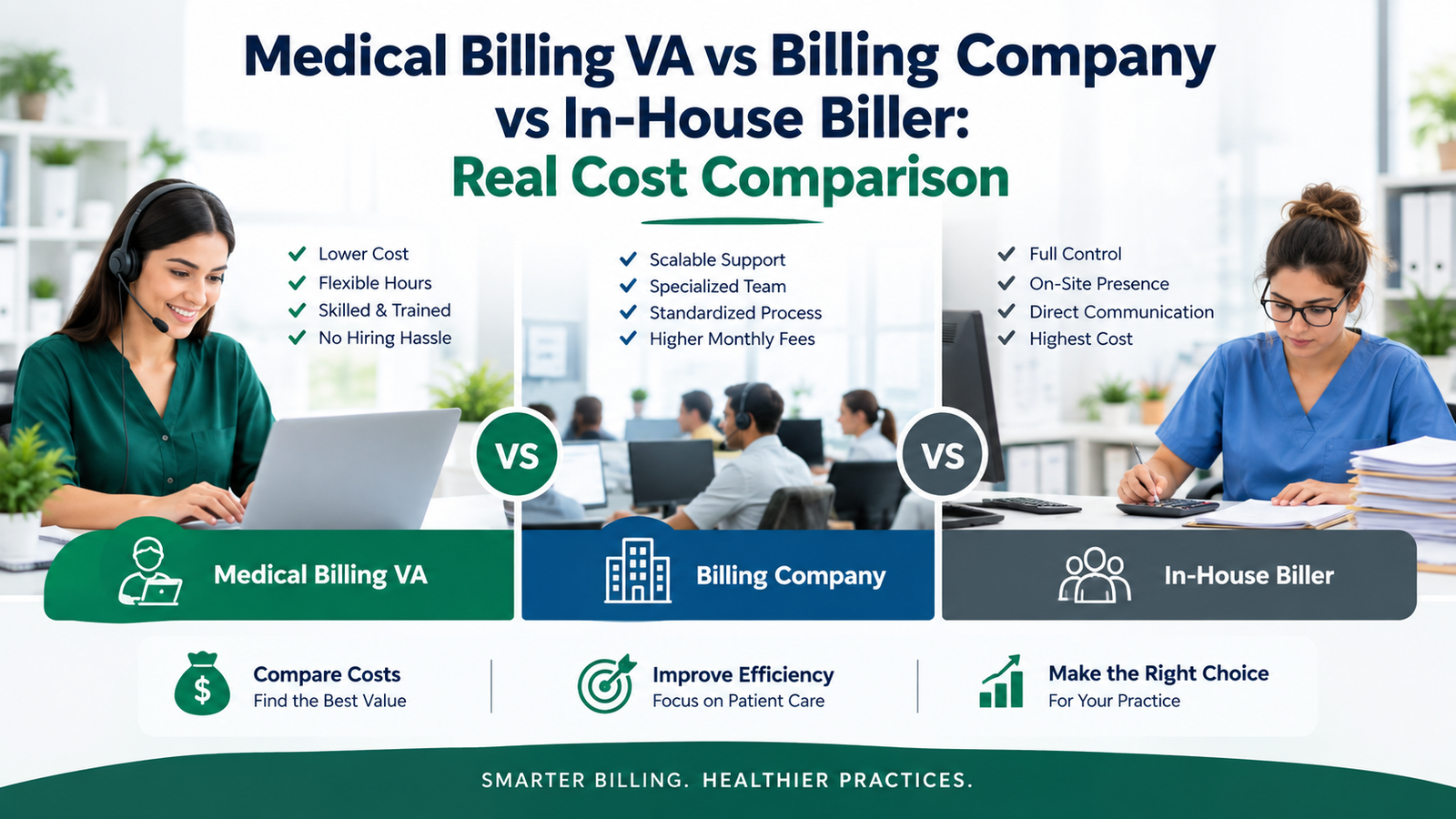
If you run a small or mid-sized practice, billing probably keeps you up at night. Claims get rejected, payments arrive late, and one experienced biller leaving can freeze your cash flow for weeks.
Most practices end up choosing between three models: hire someone in-house, outsource to a billing company, or work with a trained virtual assistant (VA) who handles billing tasks inside your own systems. Each model changes your cost, your control and your risk in a different way.
This guide compares all three honestly, with a worked cost example, so you can decide what fits your practice.
There is no universal winner. The best choice depends on your collections, your software, and how much management time you have.
You hire an employee who works from your office or remotely. You pay salary, payroll taxes, benefits, equipment and software access, and you carry the cost of training and replacement.
Strengths: direct control, knows your practice closely, easy to ask questions. Weaknesses: fixed cost even in slow months, coverage gaps during leave or resignation, recruiting time.
A third-party company takes over billing, often charging a percentage of the money collected, or sometimes a per-claim or flat fee.
Strengths: a ready team, established processes, little management from you. Weaknesses: you see less of the daily work, contracts can be long, and the percentage rises with your revenue even if your effort does not.
A VA works remotely for your practice on an agreed number of hours, using your practice management system and clearinghouse. They handle defined billing tasks and report to you or your billing lead. Our medical billing VA service is built around this model.
Strengths: lower hourly cost, flexible hours, full visibility because they work in your systems. Weaknesses: needs supervision, needs clear procedures, and some tasks (such as final coding decisions) should be reviewed by a credentialed coder.
The numbers below are illustrative assumptions, not quotes. Replace them with your own figures. [VERIFY all rates before publishing.]
Example practice: monthly collections of $50,000.
| Item | In-house biller | Billing company | Medical billing VA |
|---|---|---|---|
| Pricing basis | Salary plus overhead | % of collections | Hourly |
| Assumption | $45,000 salary plus about 25% for taxes and benefits | 6% of collections (typical quoted range is often 4% to 9%) | $[X]/hour for 160 hours a month [VERIFY from homepage; currently $5 to $6/hour] |
| Approx. monthly cost | About $4,700 | About $3,000 | About $[X × 160] |
| Software and equipment | Often extra | Usually included | Your own PM software and clearinghouse |
| Supervision needed | Moderate | Low | Moderate to high |
| Cost if collections grow to $100,000 | Same unless you hire again | About $6,000 | Same unless hours increase |
How to read this table
Also compare outcomes, not only price. A cheaper model that leaves claims unworked costs more than it saves.
A well-trained VA typically supports the repetitive, process-driven parts of the revenue cycle:
We cover these in detail in separate guides, including how a billing VA reduces claim denials (publish hone ke baad activate karein), the eligibility verification checklist (publish hone ke baad activate karein), and the daily ERA and EOB posting routine (publish hone ke baad activate karein).
Honesty matters here, and it protects you from bad hires.
| Your situation | Likely best fit |
|---|---|
| Solo or small practice, low monthly collections, owner can supervise | Medical billing VA |
| Growing practice with a billing lead who needs more hands | Medical billing VA |
| Mid-sized practice, complex payer mix, no time to manage billing | Billing company |
| Large steady volume, want daily control and local presence | In-house biller (or a hybrid) |
| Want to keep control but cut cost | In-house lead plus VA support |
| Need specialty billing (for example, physical therapy or mental health) | Check the specialty experience of any option first |
The hybrid model is common. Many practices keep one experienced biller or billing manager and add VA support for eligibility, posting and follow-up. This protects against a single point of failure and keeps costs under control.
If you work in a specific specialty, see how a dedicated medical virtual assistant supports clinics, or read about hiring a virtual assistant for a healthcare practice.
Is a medical billing VA cheaper than a billing company?
Often, yes, on pure hourly cost. But a VA needs supervision and your own software, so compare the total cost and the results, not only the rate.
Can a virtual assistant replace my in-house biller completely?
For some small practices, yes. For others, a hybrid works better, with one lead biller and VA support for routine tasks.
Is it legal to use an offshore medical billing VA?
Offshore billing support is common, but you must follow HIPAA and your payer contracts, and have a signed BAA in place. Confirm requirements with your compliance advisor. This article is general information, not legal advice.
What percentage do billing companies usually charge?
Quotes vary by specialty, volume and services included. Many fall somewhere between about 4% and 9% of collections. Always ask what is included.
How do I measure whether my billing model is working?
Track days in accounts receivable, first-pass claim acceptance, denial rate and net collection rate. Compare them before and after any change.
We typically reply in minutes
👋 Welcome! Tell us a little about yourself and we'll help you find the right virtual assistant.
WhatsApp us